Cyber attacks are becoming a growing concern for businesses, with new research reporting a sharp rise in activity targeting UK organisations. From phishing emails to ransomware, businesses need to understand the risks they face and make sure their IT systems are properly protected.
Cyber Attacks Against UK Organisations Rise by 50%
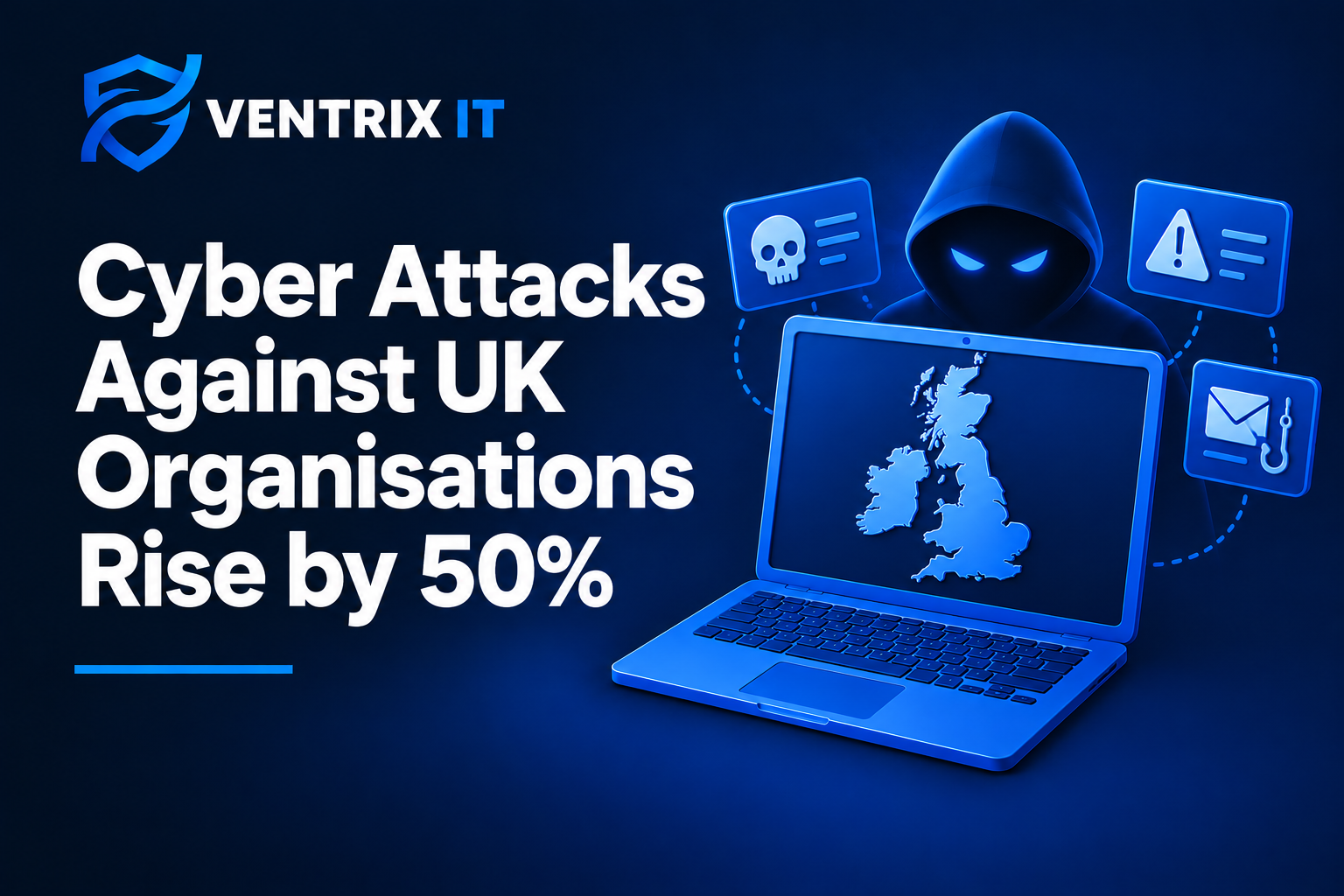
Cybersecurity research published by Check Point Research in October 2026 found that UK organisations experienced an average of 1,920 cyber attacks per week in September. This represented a 50% increase compared with September 2025.
The same report found that organisations worldwide experienced an average of 2,803 attacks per week, up 48% year on year. The figures highlight the level of activity being detected across the networks and systems monitored by Check Point’s security technology.
These figures should be understood in context. They represent attacks observed in Check Point’s threat intelligence data, rather than a complete count of every attack against every UK business. However, they provide a useful indication of the threats organisations are facing.
The UK Government’s Cyber Security Breaches Survey 2025/2026 provides a different perspective. Published in April 2026, it found that 43% of UK businesses had identified a cyber security breach or attack in the previous 12 months, equivalent to approximately 612,000 businesses.
Together, these findings underline why cyber security needs to be an ongoing business priority, rather than something that is only addressed after an incident.
What Types of Cyber Attacks Should Businesses Be Concerned About?
Cyber attacks take many forms, and not all require sophisticated technical skills. Some of the most effective methods rely on exploiting everyday business processes, employee trust or weaknesses in existing security controls.
Phishing and Email Attacks
Phishing remains one of the most common ways attackers target businesses. These attacks typically involve fraudulent emails or messages designed to persuade employees to click a link, open an attachment or disclose sensitive information.
Messages may impersonate suppliers, colleagues, senior managers or familiar online services. Some are designed to steal Microsoft 365 login details, while others attempt to redirect payments or obtain confidential business information.
The UK Government’s 2025/2026 survey identified phishing as the most frequently reported type of cyber breach or attack, affecting 38% of businesses.
Businesses should not rely solely on employees spotting suspicious messages. Email filtering, multi-factor authentication (MFA), appropriate access controls and staff awareness all help reduce the likelihood of a successful attack.
Ransomware and Data Theft
Ransomware is malicious software that can prevent an organisation from accessing its files and systems. Attackers may also steal confidential information and threaten to publish it unless a ransom is paid.
The consequences can extend well beyond the immediate IT problem. Staff may be unable to work, customer services may be disrupted, and sensitive information could be exposed.
Backups are an important part of protecting against ransomware, but simply having a backup is not enough. Businesses need to know that their backups are protected, that they can be restored and that recovery procedures have been tested.
Endpoint protection, regular patching, restricted access privileges and security monitoring can also help reduce the risk of an attack and limit its impact.
Attacks Exploiting Outdated Software
Software vulnerabilities can give attackers a way into business systems when security updates have not been installed.
Operating systems, business applications, network equipment and other connected devices all need appropriate maintenance. When vulnerabilities remain unpatched, organisations may be exposed to weaknesses that attackers already know how to exploit.
Keeping systems updated requires more than installing every update immediately. Businesses also need to consider compatibility, testing, deployment and whether updates have completed successfully.
A managed IT provider can take responsibility for monitoring systems, prioritising updates and addressing issues before they become a larger problem.
Why Small and Medium-Sized Businesses Should Take Notice
Cyber security is sometimes treated as a concern primarily for large enterprises. In reality, businesses of all sizes rely on technology to communicate with customers, process payments, manage information and deliver their services.
Smaller businesses may have fewer internal resources dedicated to security. They might also depend on a small number of key systems or employees, meaning that even a relatively contained incident can cause significant disruption.
The risks are not limited to losing access to files. A successful attack could result in:
- Business disruption: Staff may be unable to access essential applications, email or shared files.
- Financial losses: Fraud, recovery costs, lost revenue and potential ransom demands can all affect the business.
- Data exposure: Customer records, employee information and commercially sensitive documents could be compromised.
- Reputational damage: Customers and suppliers may lose confidence if information is not adequately protected.
- Compliance concerns: An incident involving personal data may trigger reporting obligations and regulatory scrutiny.
The right level of protection will depend on the organisation, the information it handles and how it operates. The important thing is to understand the risks and have suitable safeguards in place.
What Can Businesses Do to Reduce Their Cyber Security Risk?
There is no single product or setting that prevents every cyber attack. Effective protection comes from combining sensible security controls with consistent management and monitoring.
- Keep Systems and Software Updated
Apply security updates to operating systems, applications and network equipment in a controlled and timely manner. Identify unsupported software and plan upgrades before it becomes a significant security or compatibility issue.
- Strengthen Email and Account Security
Use multi-factor authentication, appropriate email security controls and access policies. Review who has access to important systems and remove unnecessary permissions.
Businesses using Microsoft 365 should pay particular attention to account security, suspicious sign-in activity and the configuration of their identity and access controls.
- Protect Devices and Monitor for Threats
Business laptops, desktops and servers need appropriate endpoint protection. Security monitoring can help identify suspicious activity that might otherwise go unnoticed.
For organisations that need a higher level of protection, managed detection and response (MDR) can provide additional monitoring and investigation, supported by security professionals and a security operations centre (SOC).
- Maintain Reliable, Tested Backups
Back up important business information regularly and protect backups against unauthorised access or deletion. Test the restoration process so you know that critical data and systems can be recovered when needed.
- Help Employees Recognise Suspicious Activity
Provide practical guidance on phishing, unusual payment requests, unexpected login prompts and suspicious attachments. Employees should know how to report a concern without worrying about being blamed for raising it.
Training works best alongside technical controls. Even experienced employees can be caught out by convincing messages, particularly when attackers impersonate trusted contacts.
- Review Your Security Regularly
Security requirements change as businesses grow, employees join or leave, and new applications are introduced. Regular reviews help identify gaps, check that existing controls are working and establish what needs to improve.
A useful review should consider devices, user accounts, email, cloud services, backups, software updates and the procedures used to respond to an incident.
Why Proactive IT Management Matters
Cyber security is not a one-off project. New vulnerabilities emerge, employees change roles, software evolves and attackers adapt their methods.
This is why businesses need to look beyond reacting to IT problems when they occur. Proactive management means maintaining systems, reviewing security settings, monitoring for suspicious activity and dealing with potential issues before they cause unnecessary disruption.
A managed IT service provider can bring these responsibilities together, helping businesses maintain their technology while ensuring that security remains part of everyday IT management.
For businesses without a dedicated internal IT team, this can provide access to ongoing technical support and security expertise without having to build a complete in-house department.
Managed IT and Cyber Security Support in Kent
At Ventrix IT, we help businesses across Kent and the South East manage, maintain and secure their IT systems.
Our managed IT services bring day-to-day IT support together with proactive maintenance and cyber security, helping businesses keep their systems reliable and their information protected. Where appropriate, this includes Microsoft 365 security, endpoint protection, monitoring and managed detection and response.
We believe good IT support should be proactive, personal and built around the needs of your business. Rather than waiting for problems to disrupt your working day, our aim is to help identify issues early and keep your technology working as it should.
If you’re unsure whether your current IT arrangements provide the right level of protection, Ventrix IT can help you review your setup and identify practical improvements.
Find out more about our managed IT services and how we support businesses across Kent.
Sources
- Check Point Research, September 2026 Cyber Threat Landscape, published October 2026: https://blog.checkpoint.com/research/september-2026-cyber-threat-landscape-global-attacks-jump-48-as-phishing-and-genai-data-exposure-rise/
- UK Government, Cyber Security Breaches Survey 2025/2026, published 30 April 2026: https://www.gov.uk/government/statistics/cyber-security-breaches-survey-20252026/cyber-security-breaches-survey-20252026